A prop trading firm whose rules and payouts run on Ethereum.
ChainFunded evaluates traders and pays the ones who pass. Fees, trader payouts and the liquidity pool that backs them are held and moved by a smart contract, so anyone can check the money and the rules for themselves.

Traders have to trust the firm that pays them.
In a typical prop firm, the evaluation rules, the payout decision and the money all sit inside one company. Traders cannot see whether the firm can afford to pay, and payouts wait on a manual review.
ChainFunded moves the money and the final rule check into a contract on Ethereum. The fee a trader pays, the pool that funds payouts and every payout itself are public transactions. Trading runs off-chain, where it is fast and cheap, and only the result comes back on-chain to be checked and paid.
How a dollar moves through the system
Four steps, from the fee a trader pays to the USDC that lands in their wallet. Steps 1 and 4 are on Ethereum; steps 2 and 3 run on our worker.
Pay the fee
The trader signs a USDC payment from their own wallet. The contract registers the challenge with its rules and splits the fee between the liquidity pool, the protocol and any affiliate.
Trade on live prices
The terminal streams Hyperliquid prices for crypto and eToro prices for FX, commodities and stocks. Orders fill at the bid or ask with real fees and funding, and stale prices are refused.
Record and attest
Every fill, fee and close is written to an append-only ledger that the database will not let anyone edit or delete. When a trader claims, the worker computes their results from that ledger and the signers sign them.
Verify and pay
The trader submits the signed result. The contract checks the signatures, re-checks every rule against the challenge, confirms the pool can cover it, and sends USDC to the trader in the same transaction.
What traders see

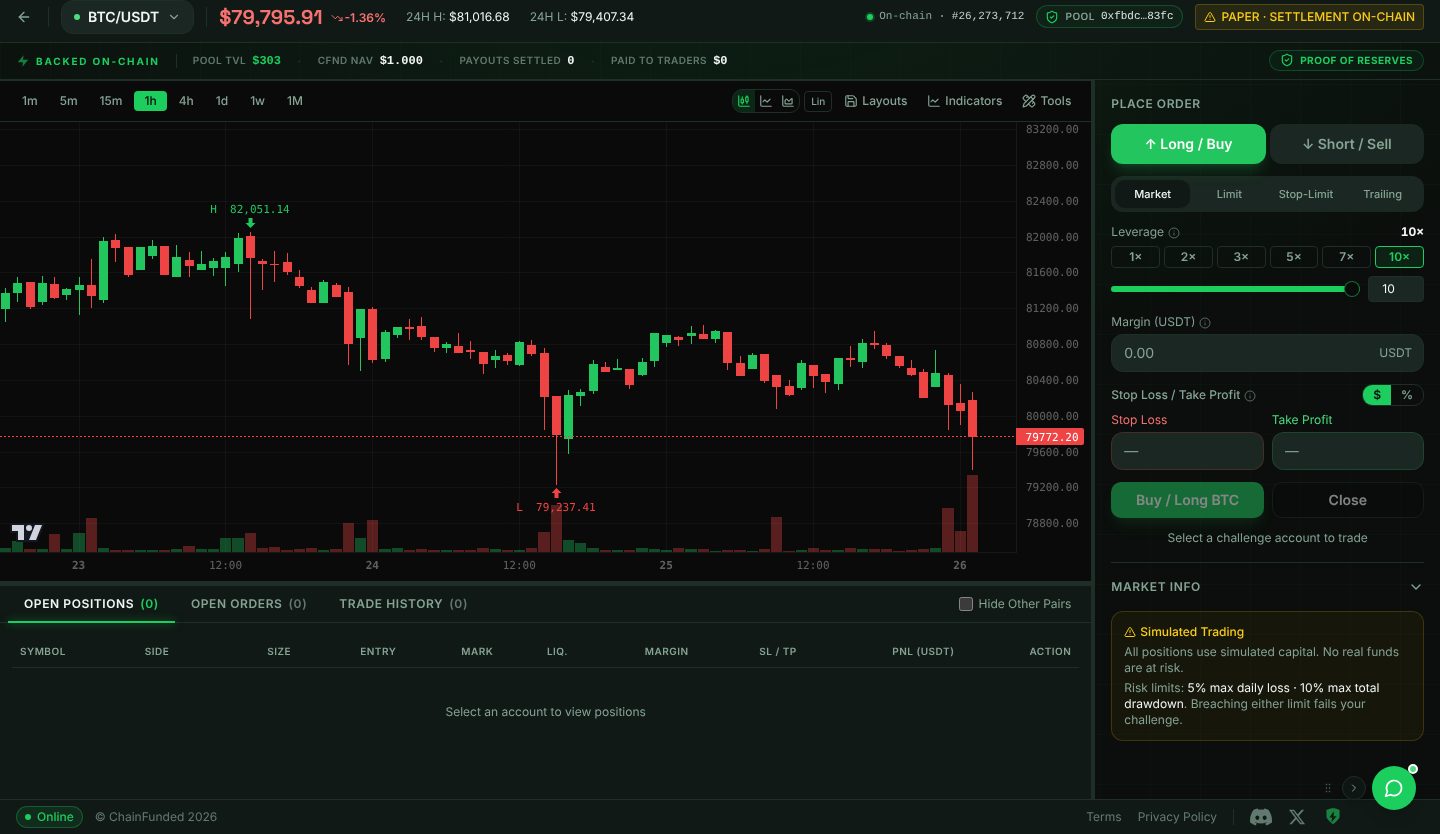
Three layers, one set of numbers
The contract, the worker and the app each hold part of the system. The hard engineering is keeping all three in agreement about every account, fee and payout.
The pool and the payout
- A core pool contract of about 1,770 lines: challenges, fee splits, LP deposits and withdrawals, payouts and affiliate commissions.
- Payouts need signatures from several authorised signers, sorted so none can be counted twice.
- Token, vesting, presale and LP reward contracts around it.
- Hardhat unit, end-to-end and integration tests.
Prices, fills and the ledger
- 35 modules: price feeds, order execution, trading costs, risk checks, claims and signing.
- Holds every exchange connection, so the browser never calls an exchange directly.
- Freshness guard refuses fills on stale or wide prices.
- Append-only ledger in Postgres, locked by database triggers, which the claim metrics are computed from.
Wallet-first front end
- React 18 and Vite, with Tailwind and shadcn components.
- Users connect their own wallet through thirdweb and sign every transaction themselves.
- Trader, liquidity provider, affiliate and admin dashboards, plus a public proof-of-reserves page.
- Vitest component and logic tests.
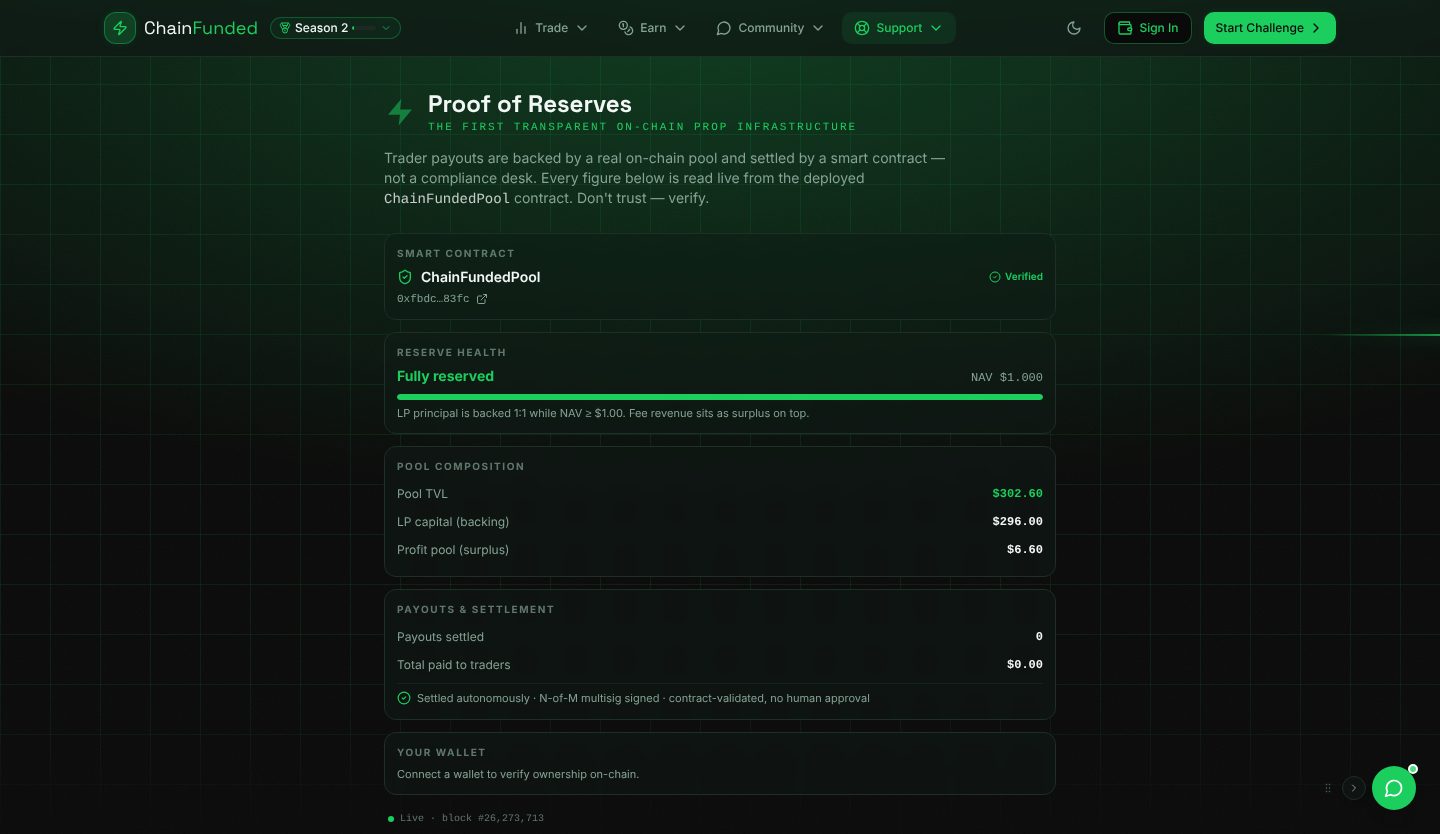
Proof of reserves, read straight from the chain
The proof page reads the pool's balances from the contract every time it loads, so traders and liquidity providers see the same numbers the contract uses to decide whether a payout can be made.
The same skills, applied to your build
Trading and investment systems
Live multi-venue pricing, realistic fills, fees and funding, and risk rules enforced as people trade.
Payments and rails
Fee splits, pooled capital and automated payouts in stablecoins, with solvency checked before money moves.
Data, ledgers and reconciliation
Append-only records that can't be quietly changed, reconciled against what the contract holds.
Blockchain and smart contracts
Contracts that hold real funds on mainnet, multi-signer attestation and replay-safe proofs.
Building something that moves money?
Tell us what you're building and we'll come back with how we'd approach it.